Wednesday, April 23, 2014

"Noise Hampers Children’s Expressive Word Learning”

We have been catching up on some reading in trade journals and thought the following might be of interest.

In an article entitled, “Noise Hampers Children’s Expressive Word Learning,” children ages 9-11 heard new words in meaningful discourse, but some heard the words in white noise, while others heard them in a quiet environment.  Children who learned the words in quiet were able to produce and use the words more accurately than the children who heard the words in noise.  In addition, children were exposed to clear speech (slow, well-articulated) as well as plain speech (how we usually talk), and children who heard the new words in clear speech were able to produce and use the words more accurately than the children who heard the words in plain speech.

So what can you do at home? 

•   Remember that children learn words through listening as well as reading and writing.
•   Speak a little slower and a little more clearly with your children. 
•   Turn off the TV when children are working on schoolwork, and even when you are engaged in conversation.
•   Creating a quiet space and speaking clearly with your child are low-tech ways to help your child get ahead.


Tuesday, April 15, 2014

Learn language skills with a treasure hunt!

Last week we shared ideas about how to modify our Centsible Kids game, and with the modification seed planted in our brains, we've decided to continue with a spring bent on it....

An Easter egg or basket hunt!

Many families already put together a treasure hunt for this holiday.  We're proposing modifying it a bit to challenge children's language skills.  Instead of just going out to look for the eggs, give verbal or written clues for each hiding place.  For example, you might say to a younger child, "I spy a yellow egg under a short plant with lots of buds on it, and this plant is by the porch."  The child should look under the bushes.  Using descriptive language like in the example allows for 2 important things:

1. You are providing the pattern of definitions.  Stating the category (plant) and important attributes (lots of buds, short) as well as function, are the keys to clear definitions.

2. Children have to listen to longer pieces of information.  Since the hunt is motivating, children will listen to more complex bits of information.

For children who are able to read, you can put clues inside the eggs to lead them through the hunt.  Again, descriptive language can be a nice challenge for any child - typically developing or with language learning issues.  As older kids start to lose interest in the hunt, engage them in creating and giving clues to the younger ones.


Whatever your traditions are at this time of year, a treasure hunt outside can be great fun!

Monday, April 7, 2014

April is Financial Literacy Month!

We were just reading on Edutopia that April is Financial Literacy month and we are excited because this dovetails nicely with our plan to share how to modify Centsible Kids.  

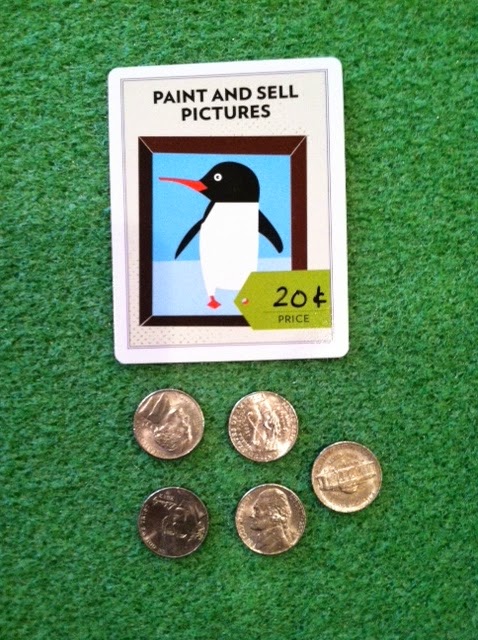
While the game is designed for children ages 9-14 it is easy to modify our money math game for younger children.  If children are learning about the value of coins and how to count them, one fun idea is to use actual coins with the game.  

In the example for selling pictures for $.20 each, the parent or teacher would write the amount on the game card, and would have the child count out nickels to add up to $.20.  

Tailor the experience to your child’s or student’s ability.  Use pennies with the youngest child counting by ones.  If needed you may use mixed coins and have the child record amounts.  

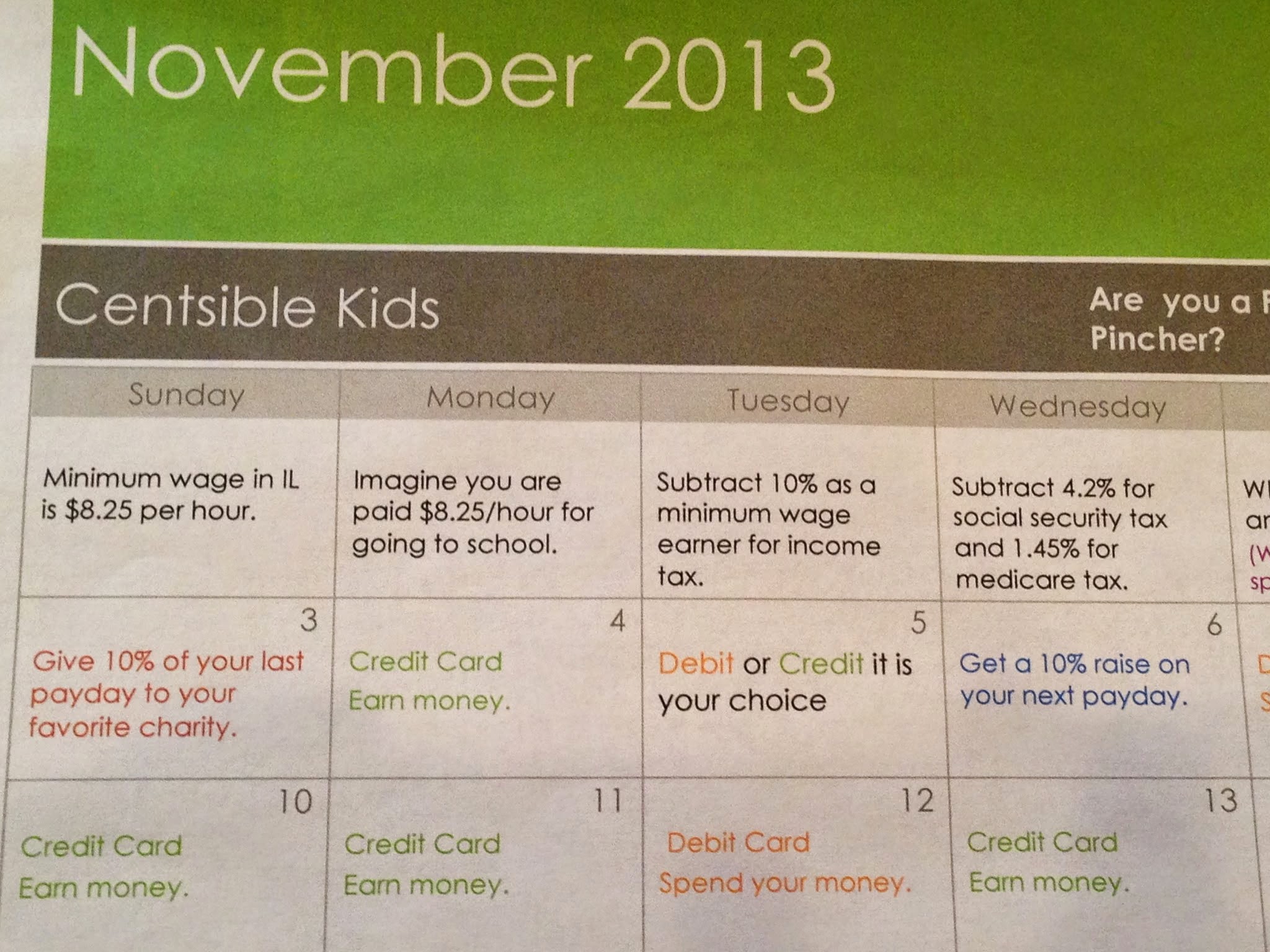
With older students, I made a calendar to be used as a game board, rolling a die and moving a game piece.  Each date on the calendar had an action to complete - like compute a salary if you are paid $8.25 for minimum wage for 2 weeks, subtract 10% for income tax, or choose a green card and earn money.  

We encourage our users to individualize the game experience to make it challenging at just the right level for their needs.  We would like to hear how you choose to use Centsible Kids!

Friday, March 28, 2014

Learning about finances with the Centsible Kids game


While we were in Dallas at the Ed Expo, it was fun to see how people would gravitate toward the Centsible Kids game. As we talked about it, they were excited about how important finances are to them, their children, and/or grandchildren.

In particular, people from Texas were looking for products as their state has new standards regarding financial education. Everyone we talked to stressed the importance of financial education starting in elementary school. Thanks to someone we met at the show, we were sent an easy to read list of the Texas Essential Knowledge and Skills Standards. They state that starting in kindergarten, children are expected to:
  • Identify ways to earn income,
  • differentiate between money received as income and money received as gifts, and
  • distinguish between wants and needs and identify income as a source to meet one’s wants and needs
As children progress through the grades, more skills are expected, and we believe that Centsible Kids helps address all of them. 


We’ve continued to research more about the Common Core Math Standards and have found other sites out there that help teachers apply the standards in a broader way. For example, in second grade, the math standard states that children are expected to:
  • Solve word problems involving dollar bills, quarters, dimes, nickels and pennies, using dollar and cent symbols appropriately.
Some sites have extrapolated this to help teachers teach financial literacy, such as delayed gratification and saving money - which Centsible Kids definitely does.

Come back next week when we will share ideas about how to modify Centsible Kids to work with children of different age and skill levels.

Lets Choose at the 2014 EdExpo in Dallas


We just got back from the 2014 EdExpo in Dallas, Texas where we got to showcase our learning games and meet some great new people. We are proud to share some new additions to stores carrying our products:
We will update you when Everything Education opens up in Canton, Ohio as they will be selling our games, too! 

Choice-A-Quence

Choice-A-Quence has won The National Parenting Center Seal of Approval.


Parents and educators played the game with children. Reviewers felt,”It is a game that kids enjoyed but parents especially loved that they could use it as a method to develop a new dialogue and vocabulary with their kids about the consequences which arise from the decisions they make. ... this is not a punishment or lesson oriented experience, it is more of an “oh yeah!” kind of game.” 

We are proud that a group that does an eight week evaluation had such a great experience with our game.